Lighting for Emotion: Sculpting Light in Studio Portraits for Dramatic Effect
- Sinisa Zec Studio
- No Comments
- Photography, Tutorials & Techniques
Forget the megapixel count. The real conversation in a portrait happens in the shadows. For years, we’ve been taught the gospel of three-point lighting: key, fill, and rim. It’s safe, it’s clean, and it’s often incredibly boring. It produces a technically correct image that says absolutely nothing.
If you want to create portraits that hold the viewer, that have tension, vulnerability, or power, you have to stop illuminating and start sculpting. Light isn’t just for visibility; it’s the primary language of photography. Over my 15 years in the studio, I’ve learned that the most powerful tool I have isn’t my Nikon Z6 III, it’s a single, well-placed light and a deep understanding of shadow. The camera just records the decisions I make with light.
This is my approach to lighting for emotion. We’re going to break the rules, but we’re going to do it with intent.
Step 1: Create a Void (Kill the Ambient)
Before you turn on a single strobe, you need to turn everything else off. Your studio must be a black box. Close the blinds, kill the overheads, turn off the monitor screen if you have to. Your camera’s settings should produce a completely black frame with no lights on. I typically start around ISO 100, f/8, and 1/200s sync speed.
Why? Because you cannot sculpt light if you have random, uncontrolled light spilling everywhere. Ambient light is fill light you didn’t ask for. It lifts shadows, reduces contrast, and kills mood. By starting with pure black, every single photon that hits your subject is one you placed there deliberately. Control is everything.
Step 2: For Tension & Mystery – The Single Hard Light
This is the opposite of the big, soft, flattering light everyone aims for. To create a sense of drama, unease, or isolation, you need contrast. Hard light, hard shadows.
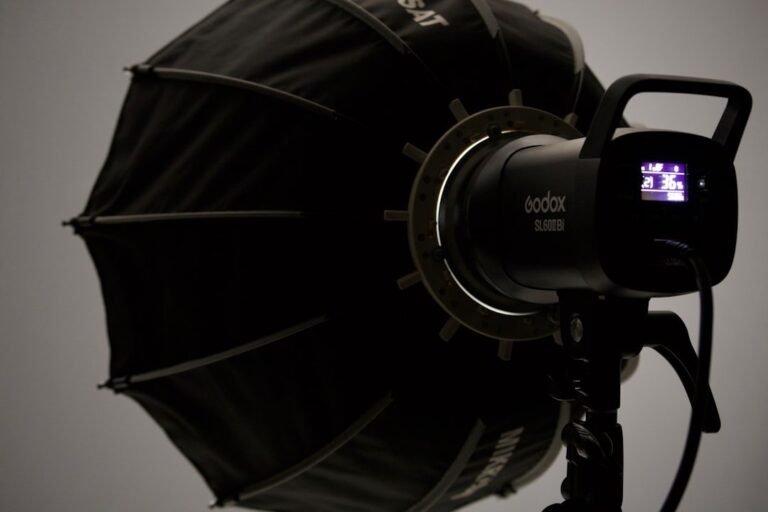
I use my Godox AD400Pro with just a standard reflector or, even better, a 20-degree grid. A grid is essential because it narrows the beam of light into a tight circle, preventing it from spilling onto the background or other parts of the scene. It’s like a spotlight.
The Setup:
Place this single, hard light high and to one side of the subject, at about a 45-degree angle down and a 45-degree angle to the side. This is a classic starting point, but the magic is in the small adjustments. Move the light further to the side (closer to 90 degrees) to create a “split light” where half the face is in shadow. This is aggressive and confrontational. Move it slightly more forward to get that classic Rembrandt triangle of light on the shadow-side cheek. This is more pensive and moody.
The hard shadow lines carve the face, emphasizing texture, bone structure, and imperfections. It’s not always flattering, but it’s always interesting. It’s a light that asks questions rather than providing easy answers.
Step 3: For Vulnerability & Introspection – The Low, Soft Source
We’re conditioned to see light coming from above—the sun, ceiling lights. It feels normal. To create a feeling of vulnerability or quiet intimacy, you can subvert that expectation by lighting from below.
Now, I don’t mean horror-movie uplighting. This is subtle.
The Setup:
Take your largest modifier—I use a 120cm Godox octabox—and place it low, often just out of the frame below the subject’s chin, angled slightly up. The key is that the light source should be massive and very close to the subject. This proximity creates a soft, wrapping light that feels incredibly personal. The light falls off very quickly, so the background goes dark, isolating the subject in their own space.
This setup mimics the light from a phone screen, a book, or a candle. It’s a private light. The subject’s expression often naturally becomes more introspective because the light feels contained and personal. It’s a fantastic way to capture a quiet, unguarded moment.
Step 4: For Power & Defiance – Extreme High-Angle Light
To give a subject an aura of power, strength, or even arrogance, you place the light where it asserts dominance. That means high up, casting strong downward shadows.
This is an evolution of butterfly or “paramount” lighting, but taken to a more dramatic extreme.
The Setup:
Place your key light (a beauty dish or a gridded strip box works beautifully) directly in front of the subject but significantly higher, angled down at 45 degrees or more. The higher you go, the more dramatic the effect. This chisels the cheekbones, creates a deep shadow under the chin that strengthens the jawline, and makes the eyes pools of shadow until the subject tilts their chin up to meet the light.
That gesture—the chin lifting to meet the light—is an act of defiance. This lighting setup forces a powerful pose. It’s a hero light, a CEO light, a villain light. It’s unambiguous in its emotional direction.
Step 5: For Atmosphere & Memory – Gobos and Negative Fill
Sometimes the emotion isn’t just on the subject’s face; it’s in the environment you create. This is where you move beyond just lighting the person and start lighting the space *around* them, even in a small studio.
A “gobo” (go-between) is anything that goes between your light and your subject to cast a pattern. It can be a dedicated metal disc with a pattern cut out, or it can be a piece of cardboard with slots cut in it to mimic light through window blinds. It can be a plant that casts a leafy shadow.
The Setup:
Use a hard light source (like in Step 2) and place your gobo in front of it. The pattern is projected onto your subject and the background. This instantly breaks up the perfect, clean studio look and creates a sense of place and time. It feels like a real moment, not a photo shoot.
But here’s the pro move: combine the gobo with negative fill. Negative fill is the act of *adding* shadows. Instead of a white reflector bouncing light into the dark areas, you use a large black card or flag to absorb light and deepen the shadows. By placing a black flag on the opposite side of your key light, you ensure the shadows cast by the gobo remain deep and rich, increasing the overall contrast and mood. You are literally painting with darkness.
This is the essence of sculpting. You are in complete control of where light exists and where it doesn’t. And in that control, you find the emotional core of the portrait.
What I’d Actually Do
- Light quality over light quantity. One well-placed hard light with a grid beats three poorly-placed softboxes every single time. Stop trying to fill every shadow.
- Shadow is your most important tool. What you *don’t* light is more important than what you do. It defines shape, creates mood, and directs the viewer’s eye. Embrace pure black.
- Emotion comes from imperfection. Technically “perfect” lighting is often the most sterile and emotionally vacant. Let the light be a little too harsh, a little too low. That’s where the story is.
Frequently Asked Questions
Do I need expensive lights to create these effects?
No, you need controllable lights. A single speedlight like the Godox V860II with a grid and a homemade gobo can create more drama than a cheap, uncontrollable LED panel.
How do you direct the model for these emotional shots?
The light does 90% of the work. I create the mood with the lighting setup and then give minimal direction, often just a single word: ‘wait,’ ‘think,’ ‘remember.’ The atmosphere guides their expression.
What’s the biggest mistake photographers make with dramatic lighting?
They are afraid of true black. They ‘save’ the shadows with too much fill light or by lifting them in post, which kills the contrast and the entire mood. You have to commit to the darkness.